Storm damage or wear and tear: how insurers decide
How an insurer separates storm damage from a worn-out roof, and the evidence that supports a claim.
 1234
Buildings insurance covers damage caused by a storm, a sudden one-off event. It does not cover wear and tear, which is gradual deterioration. On a roof the two often appear together, so insurers ask whether there was a storm, whether the damage is typical of one, and whether the storm was the main cause. Dated photographs and an independent report address all three.
Last reviewed by Matt Novell
How does an insurer assess a roof claim?
The Financial Ombudsman Service, which rules on disputes between policyholders and insurers, describes three questions it asks in storm cases. Insurers and loss adjusters work through much the same ones.
- Was there a storm on or around the date the damage is said to have happened? Weather records for your area answer this.
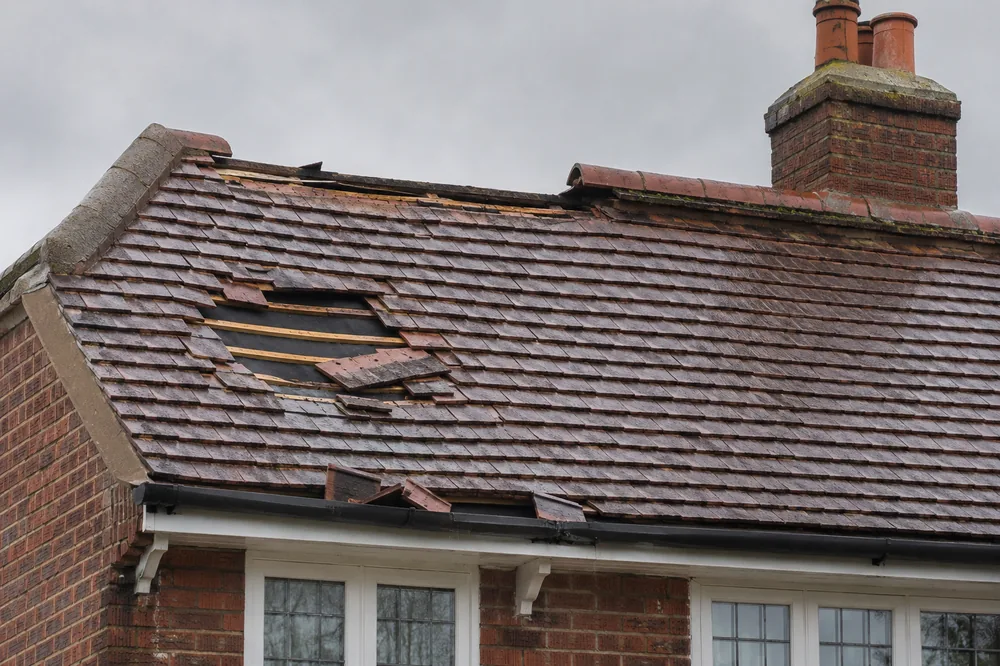
- Is the damage consistent with a storm? Tiles torn off, a ridge lifted, a chimney pot down or a branch through the roof are typical. A slow leak is not.
- Was the storm the main cause? If the roof was already failing and the wind simply finished the job, the insurer may decline.
What counts as wear and tear on a roof?
Anything that happens gradually and would have needed repair in time whatever the weather.
- Mortar at the ridge, hips and verges that has cracked and crumbled with age.
- Slates slipping because the fixing nails have corroded.
- Underfelt that has turned brittle and torn.
- Flat roof coverings that have blistered and cracked.
- Lead flashings that have split or lifted over years.
- Moss, blocked gutters and the damp they cause.
These are maintenance items, and policies exclude them. The difficulty is that a storm often exposes them. A ridge tile whose mortar had already failed is the one the wind takes.
What if it is a mixture of both?
It usually is, and this is where claims are won and lost. The honest position is to separate the two.
Take a roof where a gale has stripped ten tiles from one slope. If the rest of the roof is sound, with intact mortar and fixings, the damage is clearly storm-related. If the whole roof is loose and the storm damage is indistinguishable from the general decay, an adjuster will treat it as wear.
An independent report grades each element and states which defects are consistent with the storm and which pre-date it. That can strengthen a claim, and it can also show that part of the damage is not claimable. We report what the roof shows, whichever way it falls.
What evidence helps a claim?
Evidence gathered quickly, before anything is disturbed.
- Photographs taken as soon as it is safe, from the ground and from windows. Do not climb onto the roof.
- The date and time, and a note of the weather. Local weather records can be obtained.
- Any debris, kept where it fell or photographed in place.
- Photographs of the roof from before the storm, if you have them. Estate agent pictures and street-level imagery can help.
- Receipts for emergency work, such as a tarpaulin or a temporary repair.
- An independent condition report with dated photographs of every slope.
Tell the insurer promptly and ask before starting permanent repairs. Most policies allow emergency work to prevent further damage, but check yours.
When is an independent report worth having?
When the claim is sizeable, when the insurer has declined or reduced it, or when the cause is unclear.
A loss adjuster works for the insurer. A roofer quoting for the repair has an interest in the size of the job. A surveyor who does neither has no stake in the outcome, and that is what gives the report weight.
If your claim has been declined and you believe the decision is wrong, the report can support a complaint to the insurer and, if that fails, to the Financial Ombudsman Service. We cannot promise a result, and we will tell you if the roof does not support the claim.
Roof Insurance Claim Report
A roof insurance claim report is an independent, photographed record of roof damage prepared to support a buildings insurance claim.
Sample report
Nine pages, fictional property: summary, lender page, graded findings and costs.
Common questions
Only if the rain was part of a storm that damaged the roof. Rain entering through a roof that was already worn is usually treated as wear and tear. Check the storm definition and exclusions in your policy.
Yes, with evidence. A report that grades each element and shows the undamaged parts of the roof were sound is the usual basis. If the insurer does not change its decision, you can complain and then go to the Financial Ombudsman Service.
Make it safe and weathertight, keep the receipts and photograph everything first. Ask the insurer before permanent repairs, because they may want to inspect the damage.
It will say what the evidence shows. We separate damage consistent with a storm from deterioration that pre-dates it, with photographs. Sometimes that supports the whole claim, sometimes part of it.
More guides
A roofer says I need a new roof. Do I?
How to test a recommendation for a new roof before you spend five figures on it.
Read the guideSagging roof: when should I worry?
Why rooflines dip, how to tell old settlement from active movement, and who should look at it.
Read the guideFlat roof flagged on a survey: what should I check?
Why flat roofs draw comment on surveys, how long each type lasts and what an inspection looks at.
Read the guideWant the roof checked properly?
Independent inspection, graded report in 48 hours, no repairs sold.
01252 447 731