Roof Surveys in Reading
Reading has more Victorian terraced housing than anywhere else we cover, laid out street after street in Katesgrove, Newtown, West Reading and Caversham for the biscuit, brewing and seed trades. Add 1930s suburbs at Tilehurst and Earley, post-war estates at Whitley and Southcote, and the flats of the centre. We survey by drone, loft and ladder, and report within 48 hours.
Roof surveys in Reading explained
Southern Roof Surveys inspects roofs across Reading, Caversham, Tilehurst, Earley, Woodley and Whitley from £199. Every slope and chimney is photographed by drone, the loft inspected from the hatch and the gutters checked from a ladder, with a graded, costed PDF report delivered within 48 hours.
Last reviewed by Matt Novell
What roofs do we see most in Reading?
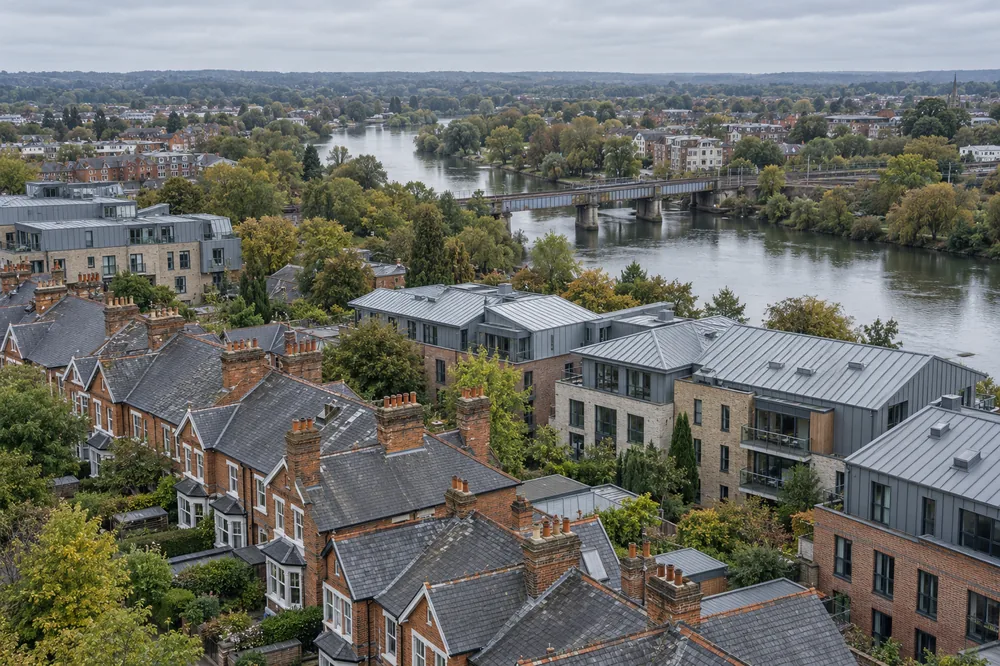
Reading's housing is predominantly Victorian and Edwardian terraces in Welsh slate and later clay tile, with a ring of 1930s suburbs in clay plain tile at Tilehurst, Earley and Caversham Heights, post-war council estates in concrete tile at Whitley, Southcote and Coley, and a town centre of converted period buildings and new apartment blocks.
The terraces come in two generations. The earlier streets in Katesgrove, Newtown and around the Oxford Road are 1860s to 1890s, Welsh slate at a low pitch, shared chimneys at every party wall and rear outriggers with lead valleys. The later Edwardian streets of East Reading, Caversham and the Tilehurst Road area moved to clay plain tile or, on the bigger villas, slate with decorative ridge tiles. Reading's local brick is good, but the chimneys were often built in soft red rubbers that have eroded badly on the stacks facing the Thames and Kennet.
Caversham across the river has two characters: the Victorian and Edwardian villas and terraces on the lower ground near the bridges, and the 1930s and post-war houses climbing Caversham Heights and Emmer Green with clay plain tile and concrete tile on hipped roofs. Tilehurst and Earley carry the largest 1930s stock, mostly plain tile semis with bonnet hips and no underfelt. The University area and Earley also have 1960s and 1970s private estates in concrete interlocking tile.
Whitley, Southcote and Coley Park were built as council estates from the late 1940s to the 1960s in concrete plain tile and interlocking tile, and Coley Park's tower blocks and the 1960s flats of the centre have flat roofs that have been overlaid repeatedly. The newest housing at Kennet Island, Green Park Village and the Station Hill towers is flat-roofed or shallow single-ply membrane, where our inspection concentrates on outlets, upstands and the condition of the membrane laps rather than tiles.
What do valuers flag on Reading roofs?
In Reading the valuer's roof comment most often follows a kerb-side view of a terrace: slipped slates, moss and a patched front slope on a Katesgrove, Newtown or Oxford Road house, with the rear and loft not seen. Chimneys are the second most frequent item, particularly the eroded soft-brick stacks on the terraces nearest the rivers.
The report gives the lender the rear slope, the outrigger, every chimney and the loft, keyed to a plan, so the further-report condition can be lifted or a retention set at a defined figure. Reading's terraces often have three or four shared stacks per house, and the lender needs each one graded with a cost band, because a rebuild of the top courses on a stack facing the Thames is £150 to £800 or more per stack.
For Whitley and Southcote the pattern matches other post-war estates: eroded concrete tiles, cracked verges and perished felt, with a retention set against the re-roof band. For the central flats and the new riverside apartments, valuers rarely raise the roof unless the block has a known leak; where they do, we need the managing agent's consent to access the roof hatch and we grade the membrane, outlets and upstands and report whether the problem is wear or a storm event.
Common roof defects in Reading
Reading's defects are those of a terraced Victorian town on two rivers: nail-sick slate, eroded soft-brick chimneys, cement-pointed ridges, blocked outrigger valleys, and moss on the north slopes of the river-side streets. The post-war estates add concrete tile erosion and perished felt; the flats add overlaid flat roofs.
- Nail-sick Welsh slate on the Katesgrove, Newtown and Oxford Road terraces, with slipped slates on tingles across the front slope.
- Soft red-brick chimneys on terraces near the Thames and Kennet eroded to a depth of 20 mm or more, with cracked flaunching and leaning pots.
- Ridge tiles on the Edwardian East Reading and Caversham streets re-bedded in hard cement that has cracked and let water into the ridge timbers.
- Lead valleys to rear outriggers blocked and overflowing, with staining on the first-floor ceiling below.
- Moss carpets on north-facing slopes of houses along the river in Caversham and on the Kennet side of Katesgrove.
- Bonnet hips loose on 1930s Tilehurst and Earley semis where the mortar bedding has weathered out.
- Concrete plain tiles on Whitley and Southcote worn to aggregate, with rendered verges cracked and felt perished at the eaves.
- Flat roofs on 1960s central flats and Coley Park blocks overlaid several times, ponding at blocked outlets.
Drone access and inspection notes for Reading
Most of Reading is clear of airfield restriction zones, but the eastern suburbs matter. Woodley sits on the former Woodley aerodrome site with no current restriction, while the Heathrow zone begins further east and does not reach Reading. RAF Benson's zone lies north beyond the Chilterns. We confirm each postcode before the visit.
The constraint in Reading is urban density rather than airspace. The terraces of Katesgrove, Newtown and West Reading have no rear access from the street in most cases, so we ask the agent for garden access for the rear slope and outriggers; where the back is reached only through the house, we do it from inside with the pole camera out of a rear window or from the garden. We do not fly over the Oxford Road, Kings Road or the IDR where traffic prevents a safe margin.
The centre around the Oracle, Station Hill and the Forbury has tall buildings that create turbulence and crowds that limit lawful flight, so central flats are inspected from the roof hatch with the managing agent's consent. Caversham's river frontage and the Thames Path, Christchurch Meadows and Prospect Park bring mature tree cover. Parking in the terraced streets is permit-controlled; we allow extra time and use visitor permits where the seller can provide one.
Areas of Reading we cover
Zone 1 — no travel charge. Same-week slots for single bookings in Zone 1; Zones 2 and 3 are run as clustered days. Postcodes RG1, RG2, RG4, RG5, RG6, RG30, RG31.
Nearby towns
Based in Fleet, Hampshire · covering Reading, Berkshire
Phone: 01252 447 731
Email: [email protected]
Hours: Mon–Fri 8am–6pm · Sat 8am–1pm
Reports: PDF within 48 hours of inspection
Roof survey prices in Reading
Prices include travel within 30 miles of Fleet. Zone 2 adds £40, Zone 3 adds £80. Add thermal leak tracing for £75, a second building for £99, or a 24-hour turnaround for £50. Card payment on booking; the report is released on payment.
Drone Roof Report
Drone survey of every slope, ridge, valley, flashing and chimney. Photographed defect schedule with condition grades. PDF in 48 hours.
Book this reportFull Roof Condition Report
Drone survey plus loft inspection, gutters and fascias, costed repair schedule and remaining-life estimate. Our most-booked report.
Book this reportPre-Purchase Roof Report
Full report plus a one-page lender summary and a 15-minute call to walk you through it before exchange. 24-hour option available.
Book this reportFull breakdown on the roof survey cost page. Questions? Call 01252 447 731.
Booking a roof survey in Reading
Book online or call
Give us the address, what prompted the survey and who the report is for. We confirm a slot, usually within five working days, and send a card payment link.
We arrange access
For a purchase we contact the estate agent or vendor directly. We need the loft hatch reachable and parking for one car; nothing else is disturbed.
Inspection, 60 to 90 minutes
Drone flight of every slope, pole camera where flight is restricted, ladder to gutter height, loft inspection from the hatch with moisture readings at any staining.
Report within 48 hours
A graded, photographed PDF with a costed repair schedule and remaining-life estimate, addressed to you and anyone else you named at booking.
Report required by your lender or solicitor?
Send us the valuer's wording or the solicitor's request when you book. We address the report to whoever needs it, quote their condition on page one, and answer it directly. Call 01252 447 731 if the mortgage offer has a deadline and we will prioritise the slot.
Other roof surveys we carry out
Pre-Purchase Roof Survey
A pre-purchase roof survey is an independent inspection of a house you are buying, carried out before exchange of contracts.
Read moreRoof Survey for Mortgage
A roof survey for mortgage purposes is an independent inspection ordered because the lender's valuer has flagged the roof.
Read moreRoof Condition Report
A roof condition report is an independent document describing the condition of every roof element, graded 1 to 3 on a traffic-light scale, with numbered photographs, a costed repair schedule in bands and a remaining-life estimate.
Read moreDrone Roof Survey
A drone roof survey is a close-range photographic inspection of a roof from the air by a CAA-registered operator.
Read moreRoof Insurance Claim Report
A roof insurance claim report is an independent, photographed record of roof damage prepared to support a buildings insurance claim.
Read moreSpray Foam Roof Inspection
A spray foam roof inspection records the type of foam applied under a roof, open or closed cell, the proportion covered, whether the rafters and felt beneath can be inspected, evidence of damp or decay, and ventilation.
Read moreLandlord Roof Inspection
A landlord roof inspection is an independent, graded condition report on a rented property's roof, loft and gutters, used to evidence compliance with Section 11 of the Landlord and Tenant Act 1985 and the Homes (Fitness for Human Habitation) Act 2018, to plan maintenance and to answer tenant damp reports.
Read moreRoof Leak Detection Survey
A roof leak detection survey traces water entry from the ceiling stain back to the external defect.
Read morePre-Solar Roof Survey
A pre-solar roof survey assesses whether a roof is fit to carry solar panels for their 25-year life.
Read moreRoof survey questions from Reading
Yes. With the seller's or agent's agreement we reach the garden through the house and use the pole camera on the rear slope and outrigger, or fly where a lawful position exists. Rear slopes on Katesgrove and Newtown terraces are where most of the patching and valley problems are, so we make a point of covering them.
Many Victorian terraces were built with soft red rubber bricks in the stacks, which erode fast when exposed to driving rain off the Thames and Kennet. We photograph every stack individually, grade the brickwork, pointing, flaunching, pots and flashings, and give a per-stack cost band of £150 to £800 or more.
No. Reading, Caversham, Tilehurst, Earley and Woodley are all clear of airfield zones. The Heathrow zone begins well to the east and RAF Benson's is north of the Chilterns. We fly subject to the usual rules on crowds, roads and private land, and use the pole camera in the busy centre and under the river-side trees.
No. Reading is inside 30 miles of our Fleet base, so it is Zone 1. Drone Roof Report £199, Full Roof Condition Report with loft and costed schedule £299, Pre-Purchase Roof Report with lender summary £399. Thermal leak tracing is £75 extra and a second building on the same visit £99.
Yes, provided the freeholder or managing agent allows access to the roof hatch or roof. We grade the membrane, outlets, upstands and any plant penetrations, photograph them, and separate storm damage from wear for insurance purposes. If access is refused we survey from the drone where lawful and mark unseen elements as NI.
The first report defines the works and the cost band so the lender sets the retention. After the roofer has finished we return for a £99 re-inspection and issue a short report with before-and-after photographs. Lenders normally require that re-inspection before releasing a retention of £5,000 to £10,000.
Yes, and most have none, which is normal for the era and not a defect in itself. We record whether the plain tiles are sound, whether daylight shows at the eaves, how the hips are fixed and whether any later insulation has blocked ventilation. The remaining-life estimate for plain tiles of this age is often decades.
With the managing agent's consent to the roof, yes. We inspect the single-ply or felt membrane, laps, outlets, upstands and any solar or plant fixings, and list defects for the developer or warranty provider. A second building on the same visit, such as a separate block or bin store, is £99.
Other towns we cover
Based in Fleet, Hampshire, covering a 90-mile radius in three travel zones. Every town below has its own page with local housing stock, what valuers flag there and drone access notes.
Book a roof survey in Reading
Fixed price, independent, PI insured, report in 48 hours. Book online in two minutes or call to talk it through first.
01252 447 731