Spray Foam Roof Inspection What Lenders Want to Know
Spray foam insulation was sold to tens of thousands of households as an energy upgrade. Today a loft lined with it is treated by many lenders as a reason to decline a mortgage or demand removal. Sellers find out at the valuation, buyers when the offer is withdrawn. We record what is there, the state of the timbers and what removal would cost, so a lender can decide.
 1234
Spray Foam Roof Inspection explained
A spray foam roof inspection records the type of foam applied under a roof, open or closed cell, the proportion covered, whether the rafters and felt beneath can be inspected, evidence of damp or decay, and ventilation. It gives a removal cost band of £1,500 to £5,000 or more, written for lenders, buyers and sellers. £299, 48 hours.
Last reviewed by Matt Novell
- Why do lenders refuse mortgages on houses with spray foam insulation?
- What is the difference between open-cell and closed-cell spray foam?
- What does the spray foam inspection record about the timbers?
- How much does spray foam removal cost?
- I am selling a house with spray foam. What are my options?
- I am buying a house with spray foam. Should I proceed?
Why do lenders refuse mortgages on houses with spray foam insulation?
Because the foam hides the roof timbers and can trap moisture against them. A valuer cannot see whether the rafters are rotting, and a lender cannot assess the risk to its security. Many lenders now decline outright or require removal before completion. Others will consider the property if an independent report confirms the foam type, coverage, timber condition and ventilation.
The problem became visible around 2022 when a wave of valuation declines hit houses that had been foamed in the previous decade, often under energy-efficiency schemes or by doorstep sellers. The foam itself is not always harmful. The lender's concern is that it prevents inspection, and in closed-cell form it can bond tiles to rafters, stop the roof breathing and conceal water entry until the timber has failed.
There is no single lender policy. Some decline any foam. Some accept open-cell foam over a breathable membrane with evidence of ventilation. Some require a report from a surveyor and then set a retention for removal. Some refer every case to an underwriter with the report. Brokers who deal with this regularly keep a list of which lenders will consider foamed roofs, and our report is written to give those lenders what they ask for.
Sellers are the ones most often caught out, because they had the foam installed in good faith and had no idea it would make the house hard to sell. The report gives them a factual basis to decide between removal before listing and pricing the removal into the sale.
What is the difference between open-cell and closed-cell spray foam?
Open-cell foam is soft, light and vapour-permeable; it can be pressed with a finger and allows moisture to pass through and dry out. Closed-cell foam is rigid, dense and vapour-impermeable; it sets hard, bonds to whatever it touches and seals the roof. Lenders tolerate open-cell more readily. Closed-cell is more likely to require removal.
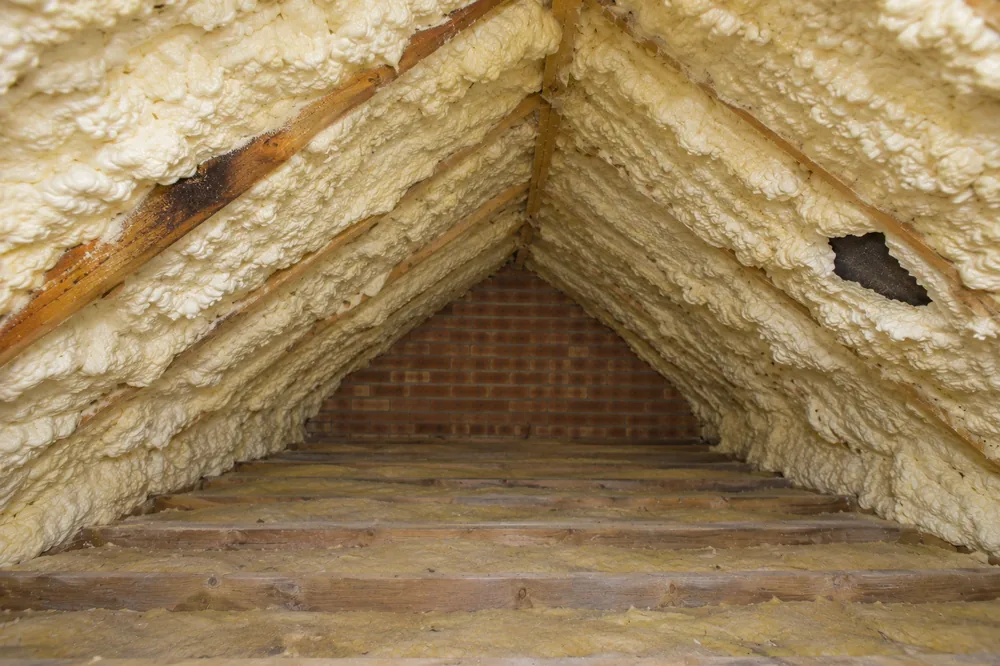
The report identifies which has been used by appearance, texture and a gentle press test on the surface of the foam at the hatch. Open-cell looks like a soft expanding sponge with an irregular surface; closed-cell is smoother, harder and often a different colour. Where both are present, or where the surface has been painted or skimmed, we say so and record the uncertainty rather than guess.
Closed-cell applied directly to the underside of tiles or slates, with no membrane between, is the case lenders worry about most. It can glue the covering to the rafters so that re-roofing means cutting out tiles, foam and sometimes battens together, and it hides the underside of the covering so that a slipped or cracked tile is not seen until water appears at a wall head. If the foam is applied over a breathable membrane with an air gap maintained at the eaves and ridge, the risk is lower and the report says so.
We also record what was there before the foam: evidence of original bitumen felt, which should not be foamed because it cannot breathe, or a modern membrane, and whether the eaves and ridge ventilation have been blocked by the application.
- Foam type: open-cell, closed-cell, or mixed, with the basis for the identification
- Application: direct to covering, over felt or membrane, to rafters only
- Coverage: estimated percentage of roof area and which slopes
- Thickness where measurable at the hatch or edges
- Ventilation: eaves, ridge, tile vents, and whether blocked by foam
- Any installer certificate, guarantee or BBA details the owner holds
What does the spray foam inspection record about the timbers?
Everything that can be seen. Where foam covers the rafters we record that the timbers are not inspectable and describe the exposed edges, the purlins, the wall plates and any timber visible at the hatch, eaves or gable. We look for staining, softness, fungal growth and the smell of damp, and we note moisture readings at accessible timber.
The honest answer in most foamed lofts is that the rafters cannot be seen. That sentence is itself what the lender needs, because it confirms that the risk the valuer identified is real and that the only way to assess the timber is to remove the foam. Where some rafters are exposed, we photograph and probe them and give a view on whether the pattern of decay, if any, suggests a wider problem.
From the drone, we photograph the external covering in detail because a foamed roof's covering has to be in good condition: any defect that lets water in will be absorbed by the foam and held against the timber. A Grade 2 slope on a normal roof may be a Grade 3 on a foamed one, and the report explains why the grade is higher than the covering alone would justify.
The report also records ventilation in practical terms: is there an air path from the eaves to the ridge, are the soffit vents clear, is there condensation on the foam surface or on the hatch frame in cold weather. Lack of ventilation is the mechanism by which foam causes damage, so its presence or absence is central to the lender's view.
How much does spray foam removal cost?
Removing spray foam from a typical three-bedroom loft costs £1,500 to £5,000 or more, depending on foam type, thickness, coverage and whether the covering has to come off. Open-cell on a membrane is at the lower end; closed-cell bonded to tiles is at the top or beyond, because the only clean method is stripping the roof.
Removal is done by scraping, cutting and sometimes by mechanical means from inside the loft. Open-cell comes away in sheets and the membrane beneath is often reusable if it was a modern breathable type. Closed-cell leaves residue on the rafters that is difficult to clean off, and where it has bonded to the back of tiles, each tile has to be freed individually or the roof re-covered. For a bonded closed-cell roof, the practical answer is often a re-roof, and the band for that is £4,000 to £15,000.
Our report gives a removal band for the specific loft, separate from any other repair bands, and marks it 'budget indication, not a quotation'. It also says whether we think removal alone will satisfy the condition, or whether the timbers underneath are likely to need repair once exposed, which affects the retention a lender might set.
We have no relationship with removal contractors. Some removal firms offer 'free surveys' and some are linked to the companies that installed the foam. If you want an opinion on whether removal is needed at all, it should come from someone who is not paid for the removal.
I am selling a house with spray foam. What are my options?
Three. Remove the foam before listing, so the question never arises. Keep it and obtain an independent report so buyers' lenders can make an informed decision, accepting that some lenders will still decline. Or price the removal into the asking price and make the report available in the sales pack so buyers go to a lender that will consider it.
Removal before listing is the cleanest route and the most expensive up front. For open-cell on a membrane at £1,500 to £2,500 it is often worth it, because the alternative is a smaller pool of buyers and a lower price. For bonded closed-cell, the cost of removal or re-roofing may exceed the discount a buyer would want, and the report helps you make that calculation with figures rather than fear.
If you keep the foam, the report in the sales pack does two things. It stops the surprise at valuation, because the buyer and their broker know before they apply which lenders to approach. And it gives the lender's underwriter the information they need on day one rather than after a declined valuation and a second application.
Cash buyers and buy-to-let investors are less affected, though both will discount for the foam. If the house has been on the market and a sale has already fallen through because of the loft, the report is the document that stops the next one going the same way.
I am buying a house with spray foam. Should I proceed?
Only with an independent inspection and a lender that has confirmed in principle it will consider the property. Ask the seller for the installer's paperwork. Get the foam type, coverage, timber condition and ventilation recorded. Then let your broker approach lenders with the report. Expect a decline, acceptance on the report, or a retention for removal.
Buyers often ask whether they should simply negotiate the removal cost off the price and proceed. The difficulty is that most lenders will not lend until the foam is gone, so the removal has to happen before completion and the seller rarely wants to pay for it on a house they are leaving. A retention is the usual compromise: the lender holds back the removal cost, you fund the gap on completion, remove the foam, and we re-inspect for £99 to release the retention.
The bigger risk is what is under the foam. If the rafters have been wet for ten years behind closed-cell foam, removal exposes decay that costs more than the foam did. Our report gives a view on that likelihood from the external covering condition, the ventilation, the age of the foam and any exposed timber. It cannot promise what is behind the foam; it tells you the signs.
If the seller refuses access for an inspection, treat that as the answer. If the report comes back with open-cell foam over a modern membrane, clear eaves ventilation and a Grade 1 covering, the house is usually mortgageable with the right lender and the price should reflect the eventual removal, not a disaster.
What does the report cover?
- Foam type identification: open-cell, closed-cell or mixed
- Application method and whether a membrane or felt is beneath
- Estimated coverage by slope and overall percentage
- Condition of all visible timber at hatch, eaves, gables and exposed rafters
- Moisture readings at accessible timber
- Ventilation assessment: eaves, ridge, soffit vents, condensation signs
- External drone survey of the covering with grades reflecting foam risk
- Removal cost band specific to the loft, £1,500 to £5,000 or more
- Opinion on whether removal alone is likely to satisfy a lender condition
- Record of any installer paperwork, guarantee or certification held
- Report written to answer lender underwriting questions
- Re-inspection after removal for retention release, £99
From booking to report in four steps
Book and send the paperwork
Book the Full Roof Condition Report at /book/. Note that spray foam is present and attach any installer certificate or the lender's wording.
Loft and drone inspection
We identify the foam type, map coverage, check all visible timber and ventilation, and photograph the external covering in detail. 60 to 90 minutes.
Lender-ready report
Within 48 hours. Foam findings, timber condition, ventilation, removal band and an opinion on whether removal is likely to be required. Addressed to the lender if asked.
Re-inspection after removal
Once the foam is out, we return for £99, inspect the exposed timbers, photograph them and issue an addendum for the lender to release any retention.
What does a roof survey cost?
Prices include travel within 30 miles of Fleet. Zone 2 adds £40, Zone 3 adds £80. Add thermal leak tracing for £75, a second building for £99, or a 24-hour turnaround for £50. Card payment on booking; the report is released on payment.
Drone Roof Report
Drone survey of every slope, ridge, valley, flashing and chimney. Photographed defect schedule with condition grades. PDF in 48 hours.
Book this reportFull Roof Condition Report
Drone survey plus loft inspection, gutters and fascias, costed repair schedule and remaining-life estimate. Our most-booked report.
Book this reportPre-Purchase Roof Report
Full report plus a one-page lender summary and a 15-minute call to walk you through it before exchange. 24-hour option available.
Book this reportFull breakdown on the roof survey cost page. Questions? Call 01252 447 731.
Report required by your lender or solicitor?
Send us the valuer's wording or the solicitor's request when you book. We address the report to whoever needs it, quote their condition on page one, and answer it directly. Call 01252 447 731 if the mortgage offer has a deadline and we will prioritise the slot.
Sample spray foam lender report
Four pages: foam type and extent, which timbers are concealed, moisture and ventilation findings, options with costs, and a lender statement. Fictional property, illustrative photographs.
Other roof surveys we carry out
Pre-Purchase Roof Survey
A pre-purchase roof survey is an independent inspection of a house you are buying, carried out before exchange of contracts.
Read moreRoof Survey for Mortgage
A roof survey for mortgage purposes is an independent inspection ordered because the lender's valuer has flagged the roof.
Read moreRoof Condition Report
A roof condition report is an independent document describing the condition of every roof element, graded 1 to 3 on a traffic-light scale, with numbered photographs, a costed repair schedule in bands and a remaining-life estimate.
Read moreDrone Roof Survey
A drone roof survey is a close-range photographic inspection of a roof from the air by a CAA-registered operator.
Read moreRoof Insurance Claim Report
A roof insurance claim report is an independent, photographed record of roof damage prepared to support a buildings insurance claim.
Read moreSpray Foam Roof Inspection
A spray foam roof inspection records the type of foam applied under a roof, open or closed cell, the proportion covered, whether the rafters and felt beneath can be inspected, evidence of damp or decay, and ventilation.
Read moreLandlord Roof Inspection
A landlord roof inspection is an independent, graded condition report on a rented property's roof, loft and gutters, used to evidence compliance with Section 11 of the Landlord and Tenant Act 1985 and the Homes (Fitness for Human Habitation) Act 2018, to plan maintenance and to answer tenant damp reports.
Read moreRoof Leak Detection Survey
A roof leak detection survey traces water entry from the ceiling stain back to the external defect.
Read morePre-Solar Roof Survey
A pre-solar roof survey assesses whether a roof is fit to carry solar panels for their 25-year life.
Read moreRelated guides
Sources and further reading
- RICS consumer guide: spray foam insulation explains why surveyors and lenders ask for an independent inspection.
- Property Care Association: sprayed foam inspection protocol the inspection process agreed by a working group of surveyors, lenders and the insulation industry.
- UK Finance Lenders' Handbook for conveyancers sets out what each mortgage lender requires of the buyer's solicitor.
External pages are published by the bodies named and were checked when this page was last reviewed.
Spray Foam Roof Inspection questions
No report can promise that. What ours does is answer the questions lenders who will consider foam always ask: type, coverage, membrane, timber condition, ventilation and removal cost. With those answered, your broker can approach the right lenders. Some decline all foam regardless. Our report tells you the facts; the lender decides.
Only where timber is exposed. Where foam covers the rafters we record them as not inspectable and give an opinion based on the covering condition, ventilation, foam age and any exposed timber at the eaves, hatch and gables. If decay is likely, the report says so and recommends partial removal to confirm before purchase or sale.
More often than closed-cell, particularly when it is applied over a breathable membrane with eaves and ridge ventilation intact. Several lenders will consider open-cell with an independent report. Closed-cell bonded directly to tiles is the case most lenders decline. The report identifies the type and the application so the broker knows which lenders are realistic.
£1,500 to £5,000 or more for a typical three-bedroom loft. Open-cell on a membrane sits at the lower end. Closed-cell bonded to the covering is at the top, and where removal means stripping the roof the figure becomes a re-roof at £4,000 to £15,000. The report gives a band for your loft.
Not with the lender. Scheme paperwork, installer guarantees and BBA certificates are recorded in the report because some lenders ask for them, but none of them removes the inspection problem. A guarantee from an installer that no longer trades is worth nothing. The lender's concern is the hidden timber, and only an inspection or removal addresses that.
Neither. We carry out no works and have no commercial relationship with removal, roofing or insulation contractors. That independence is why lenders and buyers can rely on the report. If you ask, we will tell you what to look for in a removal contractor, such as insurance, method statement and a written scope, but we do not name firms.
Some insurers ask about spray foam at renewal and some exclude roof timber damage where foam is present. The report gives you a factual description to answer an insurer accurately. If a claim is later made for a leak on a foamed roof, the report establishes condition on the inspection date, which separates pre-existing from new damage.
Yes, and many owners do, usually after reading about the mortgage problem. The report tells you what you have, whether it is causing harm now, whether ventilation can be improved without removal, and what removal would cost. That lets you plan rather than discover the issue when you come to sell or remortgage.
Where we carry out roof surveys
Based in Fleet, Hampshire, covering a 90-mile radius in three travel zones. Every town below has its own page with local housing stock, what valuers flag there and drone access notes.
Why not just ask a roofer?
A roofer looks at a roof to price the work they would like to do on it. That is not dishonesty, it is the job. An independent report has no work attached: every finding is graded against a fixed scale, photographed, and costed in bands so you can take it to any contractor, lender or insurer. We never quote for repairs and we have no referral arrangement with anyone who does.
If the report does find work, you choose the roofer. We will tell you what a fair price band looks like for each item, which is often the most valuable page in the document.
Based in Fleet, Hampshire · covering Hampshire, Surrey, Berkshire, Sussex and the South
Phone: 01252 447 731
Email: [email protected]
Hours: Mon–Fri 8am–6pm · Sat 8am–1pm
Reports: PDF within 48 hours of inspection
Book your spray foam roof inspection
Fixed price, independent, PI insured, report in 48 hours. Book online in two minutes or call to talk it through first.
01252 447 731